
 Krzysztof Burejza
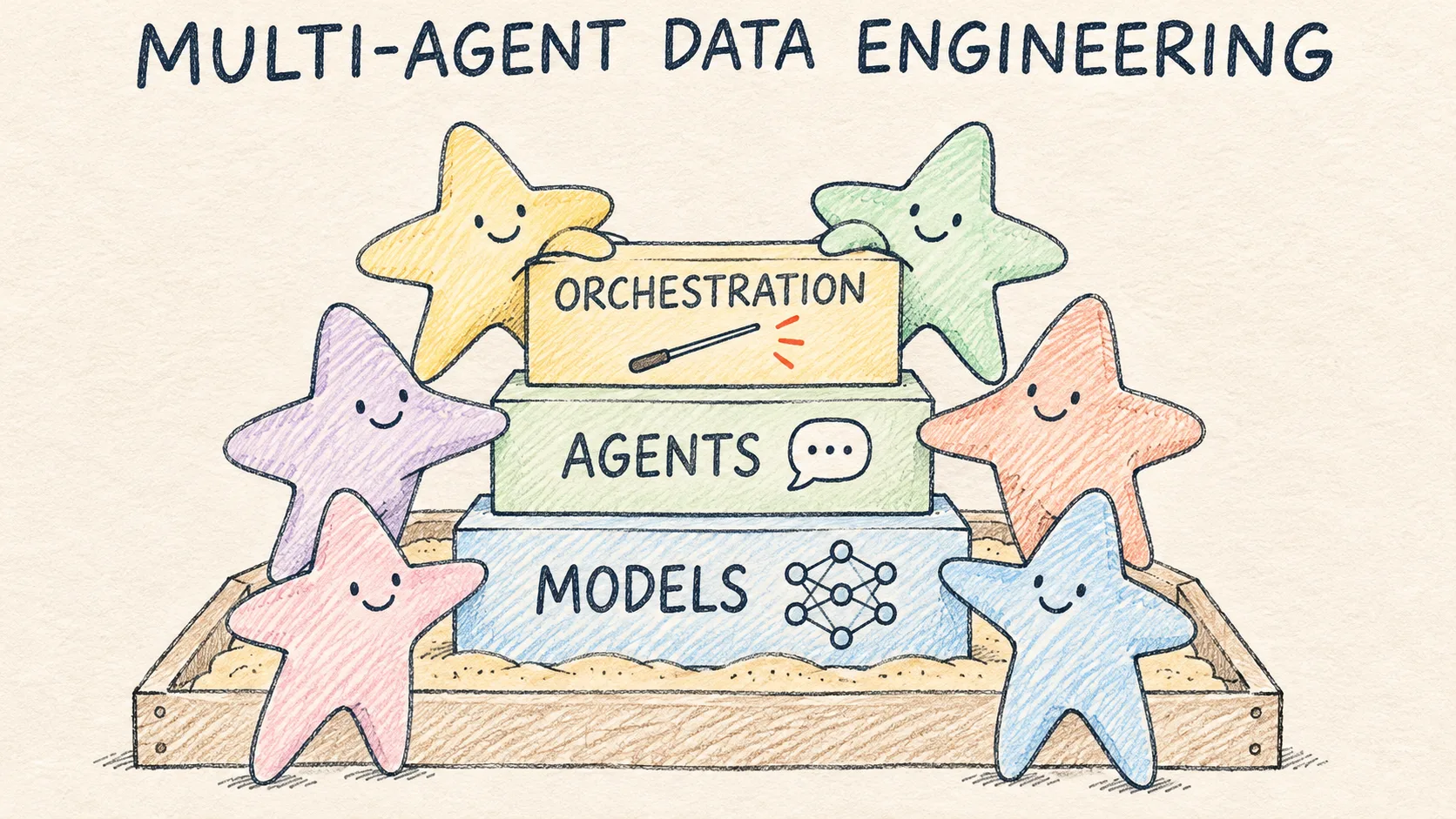
This article is based on my talk "Multi-Agent Data Engineering: Claude, Codex, Local AI and Databricks with Omnigent" at the 4th Warsaw Databricks Community meetup (27 October 2026). I work at Databricks as a Resident Solutions Architect, but this blog and its opinions are my own.
Omnigent version: I recorded the demos on 26–27 October 2026 on a development build of Omnigent 0.20.0 (commit 611429347, with one local fix in deploy.py), about 50 commits behind stable 0.20.0 (28 October 2026). The project is alpha, so commands, policy names and the UI may already differ.
Problem
Most of us work with one AI assistant that writes a pipeline, then reviews the same code and usually says it looks fine. The reviewer shares the author's assumptions, though, because it is the same model with the same context. I opened the talk with this question: "Who reviews the reviewer?"
I left a trap in the demo data for the review to find. Returns arrive as separate events with a positive quantity, so a plain SUM(quantity * unit_price) counts a return as a sale. On the demo data that sum comes to 372,479.64: 23,944.09 (the value of returns) above gross sales of 348,535.55, and 47,888.18 above the correct net revenue of 324,591.46. I expected the reviewer model to catch it, but the plan already did (Demo 3).
Why more than one agent
As in a human team, each agent can have its own role and model. A model from another vendor may catch different mistakes, sensitive code can go to a local model, and a large migration can be split across agents. N agents do not give an N times better result, though: you add coordination, cost, time, conflicting edits and the question of who is accountable. In my demos Omnigent was the layer that managed it.
What Omnigent is
Omnigent is an open-source control plane (the docs call it a meta-harness) for coding agents such as Claude Code, Codex, Pi, Cursor or Copilot. A harness is simply the agent program, and Omnigent runs it as a session you can share, govern and orchestrate.
There is also a managed version on Databricks (Beta, enabled by a workspace admin on the Previews page), but only in regions with Unity Gateway and without custom Python policies (it supports CEL policies). So I self-hosted the server on Databricks Apps.
Architecture on Databricks
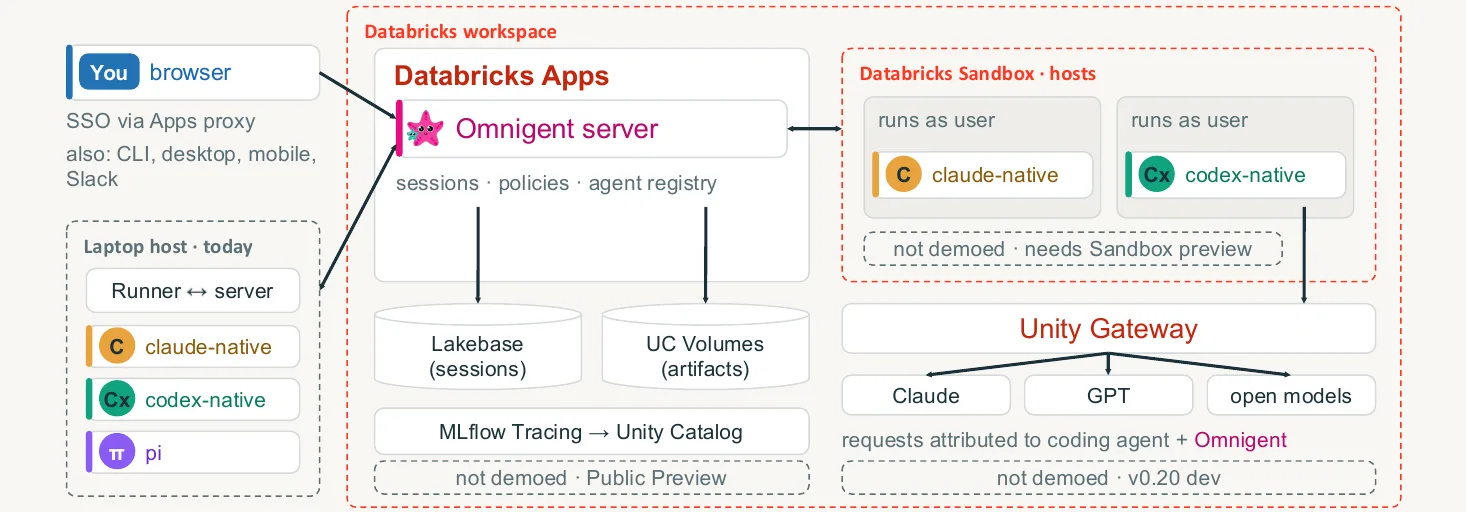
The server runs as a Databricks App, so sign-in goes through workspace SSO (Entra ID in my case). Sessions and history live in Lakebase (Postgres), and artifacts in a Unity Catalog volume. The session lives on the server and the agent works on a host (my MacBook), so the same session shows in the terminal and the browser. The parts marked “not demoed” I know only from the docs, and MLflow Tracing to Unity Catalog, labelled Public Preview in the diagram, is now GA since July 2026.
An agent is a folder of YAML
Every agent has a config.yaml with the harness (Claude Code, Codex, Pi), the prompt, the sub-agents and the guardrails. Guardrails are Omnigent policies: blast_radius blocks force-push and destructive commands and asks before a push or deploy, and spawn_bounds limits how many sub-agents start in one turn. One policy set applies to every harness through its hooks, but it controls only what the agent does in an Omnigent session and is not a security boundary against people, because anyone with the laptop can run Claude Code outside Omnigent.
To start, the plans you already have (Claude Pro/Max, ChatGPT) are enough, and you can also use an API key, an OpenAI- or Anthropic-compatible gateway or a Databricks profile with Foundation Models / Unity Gateway. My demos ran on personal subscriptions in a lab, but a team is better off with API keys and Unity Gateway, so usage is attributed to people.
Six demos
The recordings come from the lab (Azure workspace, Premium trial), with a 36 GB MacBook as the host. The data is the retailhub bundle with a generator and bronze and silver layers in Lakeflow, and the agents build the gold layer. Waits are sped up ("▶▶ ×N").
Demo 1: Omnigent in a Databricks workspace
The deploy takes a Lakebase project, a UC volume, deploy.py --no-otel, Lakebase access for the app's service principal (grant_sp_perms.py) and a second deploy. The recording starts after that: a minute of the app's resources, then Claude Code on the Mac:
✓ Tested on a Premium workspace (Azure trial, 2026-10-26): the server on Databricks Apps, the agent locally on the host; I have not tested Free Edition
omnigent claude
A question typed in the browser goes to the same session in the terminal. At the end I share the session with a second user at Edit level, who sees the whole transcript and my terminal, but their messages run on my host and subscription, so in a team everyone needs their own plan or API key.
Code for this article on GitHub →notebook and a step-by-step README · multi-agent-de-omnigent
Demo 2: Debby, Claude vs GPT
Debby is a built-in agent: a lead on claude-sdk, two sub-agents (Claude and GPT through the Codex harness) and a debate skill. I asked both whether the gold layer should be a materialized view or a streaming table and how to handle returns. Both chose a materialized view with gross, returned and net revenue, and after /debate the reasoning got more precise but the verdict did not change. I recorded Debby after Demo 3, so Claude already had gold.sql from PR #1 in the repo. The answers took about 3 minutes and the debate about 10.
Demo 3: Claude builds, Codex reviews
Polly is Omnigent's built-in orchestrator: it delegates work and asks a model from another vendor for the review, but never writes code or merges. I typed the task in the browser:
Add a gold layer to the retailhub pipeline in demo/: daily revenue per store and product category, with expectations (non-null keys, revenue >= 0). Open a PR. Claude Code implements, Codex reviews. Work in English.
- Plan (2 min 2 s). Polly read
generate_data.pyand, before any code existed, put the trap into the plan: returns arrive as positive rows, and some events have nostore_id. - Implementation (8 min 57 s). Claude Code, in its own git worktree, wrote
gold.sql, ranbundle validate, a deploy and a pipeline run in the lab (1,683 rows), then opened PR #1. It computes net revenue, so the trap never reached the reviewer. - Codex's first review stopped after 2 seconds on the ChatGPT plan limit. Polly did not switch vendors without asking, and an interim review on the local model said "PASS" with the sign logic backwards, so Polly marked it non-binding and waited for Codex.
- The Codex review (2 min 15 s) gave PASS with three nits. Polly kept two of them (and rejected the third with a reason): store uniqueness is not enforced, so a duplicate dimension row would multiply revenue, and a code comment claims more than the expectations check, because
COALESCEhides NULL keys. - At my request Polly sent both back to Claude Code. The fixes took 6 min 16 s and the Codex re-review 2 min 11 s, again PASS. PR #1 stays open, and the merge is mine.
The key part of PR #1 is a sign on every event (the full gold.sql is in the code repo):
✓ Tested on a Premium workspace (Azure trial, 2026-10-26): Lakeflow Spark Declarative Pipelines on serverless, 1,683 rows; I have not tested Free Edition
CASE WHEN o.event_type = 'RETURN' OR o.status = 'RETURNED' THEN -1 ELSE 1 END AS sign,
...
CAST(SUM(sign * gross_amount) AS DECIMAL(18, 2)) AS revenue,
CAST(SUM(CASE WHEN sign > 0 THEN gross_amount ELSE 0 END) AS DECIMAL(18, 2)) AS gross_revenue,
CAST(SUM(CASE WHEN sign < 0 THEN gross_amount ELSE 0 END) AS DECIMAL(18, 2)) AS returned_revenue,
A return gets -1, so revenue is net revenue, with gross and returns in their own columns. The OR doesn't count a return twice, because in the generator only return events have the RETURNED status. Returns are booked on the day of the return, so a day's net revenue can be negative (95 of 1,683 rows), which is why revenue >= 0 only warns and the hard rules (FAIL UPDATE) are on the three keys and gross_revenue >= 0. The agent relaxed my prompt's requirement on its own; the reasoning is sound, but a human should sign off a business decision like that.
The full Polly run was about 25 minutes of agent work (plus the quota wait) and $8.47 at list price per omnigent usage, though I actually paid through Claude Max and ChatGPT subscriptions.
Demo 4: a local model as a private reviewer
Here Pi runs qwen3-coder 30B (the 32k-context build) in Ollama, with only local Ollama models on the model list, and reviews PR #1 and silver.sql for personal data and expectations. It found a real gap, customer_name and customer_email unmasked in silver, and suggested a column mask, in 54 seconds (on the second take) and at $0 in API fees. It also had one false positive (it claimed the gold keys have no expectations; they do) and approximate line numbers. Fine for a first pass, but I would not base a merge decision on it.
Demo 5: private review, the cloud model never sees the files
In the private-review agent, local_reviewer (Pi in Ollama) reads silver.sql and the PR #1 diff on the laptop, and the judge (Claude on claude-sdk) grades only the review text. The judge gets no file or shell tools from its harness, and a CEL policy rejects other calls such as ui_open_file (the allowlist alone would let read through, because local_reviewer needs it). One of the agent's four policies (the rest are in the code repo):
✓ Tested on a Premium workspace (Azure trial, 2026-10-27): the Omnigent server, local_reviewer locally in Ollama; I have not tested Free Edition
guardrails:
  policies:
    tool_allowlist:
      type: function
      function:
        path: omnigent.policies.builtins.cel.cel_policy
        arguments:
          expression: >-
            event.type != "tool_call" ? {"result": "ALLOW"} :
            (has(event.data.name) && event.data.name in
            ["sys_session_send", "sys_read_inbox", "sys_cancel_task", "ToolSearch",
            "read", "grep", "find", "ls"])
            ? {"result": "ALLOW"}
            : {"result": "DENY", "reason": "private-review: the cloud judge may only dispatch local_reviewer and read its final report; local_reviewer may only read files. Shell, write, browser and session-history tools are blocked."}
    # ... reviewer_stays_local, review_pii_gate, pii_in_user_message
The judge rated the review "low-to-medium trust": without reading any file it noticed that the reviewer reported a check on bronze.sql it had never read, that one finding was backwards, and that the line numbers did not hold together.
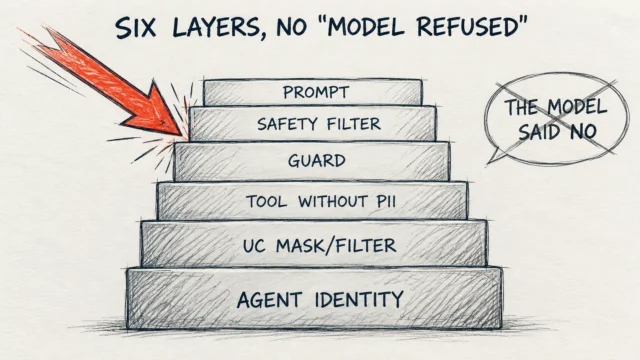
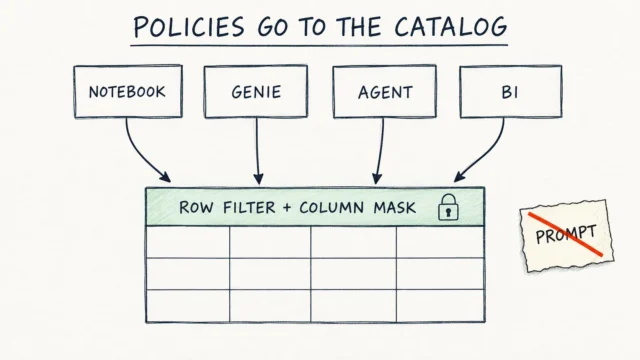
Asked to open silver.sql, the judge first declined because its prompt says so, and when I told it to call ui_open_file directly, the server rejected the call with "Denied by policy". So the block holds whatever the model decides. More on this idea in Policies go to the catalog, not the prompt and Six layers of agent defence.
The policies also block session history reads and model overrides, and withhold a review containing an e-mail address. That filter catches only e-mail addresses, so names or phone numbers would get through, and what the local model writes in its report is governed only by its prompt. Account-level connectors of the cloud model's CLI sit outside the policy, so disable them for sensitive work.
Demo 6: your own agent
Finally, I built my own team, lakehouse-reviewer: four config.yaml files and one skill with a checklist (below without the prompts; the full files are in the code repo).
lakehouse-reviewer/
  config.yaml                  # lead, claude-sdk
  agents/implementer/          # Claude Code
  agents/reviewer/             # Codex
  agents/local_scanner/        # Pi + Ollama
  skills/review-dabs/SKILL.md
The lead writes no code; it plans, delegates and combines findings:
✓ Tested on a Premium workspace (Azure trial, 2026-10-26): the Omnigent server, local_scanner locally in Ollama; I have not tested Free Edition
name: lakehouse-reviewer
executor:
  type: omnigent
  config:
    harness: claude-sdk
tools:
  agents:
    - implementer
    - reviewer
    - local_scanner
guardrails:
  policies:
    blast_radius:
      type: function
      function:
        path: omnigent.inner.nessie.policies.blast_radius
    spawn_bounds:
      type: function
      function:
        path: omnigent.inner.nessie.policies.spawn_bounds
        arguments:
          max_dispatches_per_turn: 4
In newer versions these policies live under omnigent.policies.builtins.orchestration, and the old path still works. The local scanner is a few lines:
✓ Tested on a Premium workspace (Azure trial, 2026-10-26): the Omnigent server, local_scanner locally in Ollama (Pi + qwen3-coder 30B, 36 GB MacBook); I have not tested Free Edition
name: local_scanner
executor:
  type: omnigent
  config:
    harness: pi
    model: ollama/qwen3-coder-32k:latest
On a review of PR #1, Codex (1 min 25 s) and the local scanner (1 min 54 s) ran in parallel, and the whole run to the combined table took 4 min 41 s and cost $0.97. The result: 5 blockers, 1 major, 1 minor. Only one finding was shared, unmasked personal data in silver; Codex found the other blockers: duplicate events, statuses other than sale and return counted as revenue, expectations at the wrong grain, and join fan-out in silver. The lead did not run bundle validate and flagged that in the table as a verification gap.
Privately, omnigent agent add gives you your own copy that only you can see:
✓ Tested on a Premium workspace (Azure trial, 2026-10-26): the Omnigent server; I have not tested Free Edition
omnigent agent add agents/lakehouse-reviewer
In a team, the agent is a folder in git that goes through pull requests. Across the organization, the server operator publishes it as a server agent, so in the recording a second user sees it in Settings → Custom agents without installing anything.
Cloud vs local
The fairest comparison is Demo 6 (same run, same PR), although Codex got the full checklist and the local scanner only personal data and expectations. Costs are list-price estimates from omnigent usage, since I paid through subscriptions.
| Codex (cloud) | Pi + qwen3-coder 30B (local) | |
|---|---|---|
| Review time in Demo 6 | 1 min 25 s | 1 min 54 s |
| Review cost in Demo 6 | $0.44 | $0 in API fees |
| Findings | Precise, with file and line | Found the personal data, 1 false positive, approximate lines (Demo 4) |
| Interim review during the Codex quota (Demo 3) | n/a | "PASS" with the sign logic backwards; Polly caught it |
| Code sent to a model vendor | Yes | No |
Codex called by Polly saw only the gold diff and gave PASS, while lakehouse-reviewer, with a checklist and the local scanner over the whole pipeline, reported 5 blockers. On the demo data only the unmasked personal data in silver is real, and it predates PR #1. The other four are fair concerns for future data (for example new order statuses), but do not change today's result. The gap comes mostly from prompt and scope, and these are single runs, so I would not judge Codex itself from them. As I put it at the talk: "A single LLM review is a sample, not a verdict." So make the scope and the checklist explicit.
Pitfalls
- Codex hit its ChatGPT plan quota mid-demo, which added the wait for the reset.
- "Nothing leaves the laptop" is not precise. With a local model no model vendor sees the code, but the session transcript is stored on the Omnigent server, in Lakebase.
- The Pull Requests panel showed "No open PR for main", because the PR came from the sub-agent's branch, so I attached it by hand with "Link a PR".
- Global harness settings carry over to sub-agents. My Claude Code is set to Polish, so the sub-agent's report started with "Gotowe. Raport…" although the task was in English.
- The session grid and custom agents in Settings are behind feature flags. A self-hosted deploy has to enable them, and the Databricks CLI reads a comma-separated value as a list, so in my build I changed how
deploy.pypasses it.
Where it pays off and where it does not
In data engineering a team of agents makes sense for:
- review of pipelines and bundles by a model from another vendor before merge,
- migrations split across many agents, with one worktree and one PR per notebook,
- job incident analysis by read-only agents, where a human decides,
- personal data and security audits with a local model,
- docs and change notes generated from diffs.
It does not make sense when one assistant handles the task well, when there are no tests and no run on data (bundle validate checks only the configuration, not the logic), when response time matters, and when several models cost more than they return.
For a whole team I would check identity (SSO through Databricks Apps), data access (Unity Catalog grants), models (Unity Gateway), guardrails (blast_radius, spawn_bounds, cost budgets) and that a human always merges.
Do you need Omnigent for this
Why not sub-agents in Claude Code? It depends. They split work well, but natively run on one vendor's models. For just a second pair of eyes on a PR, the simplest option is a CI action that calls another vendor's model on the diff and requires a file and line for every finding, with no extra server. Omnigent pays off when you want several vendors and a local model in one place, sessions shared with the team and server-side policies that work the same on every harness. The cost is an extra server (a Databricks App and Lakebase) and an alpha project.
What's next?
To try it, I would start with one small pipeline PR reviewed by another vendor's model, and require the change to pass bundle validate plus tests or a run on data. The Databricks Apps guide is in the project repo, and the install guide at omnigent.ai/quickstart/install.
I closed the talk with three sentences: "Let the agents disagree. Make them show their evidence. Own the merge."
Want more posts? Follow along via RSS or on LinkedIn.
Comments
Quiet on the trail so far. Be the first to comment.